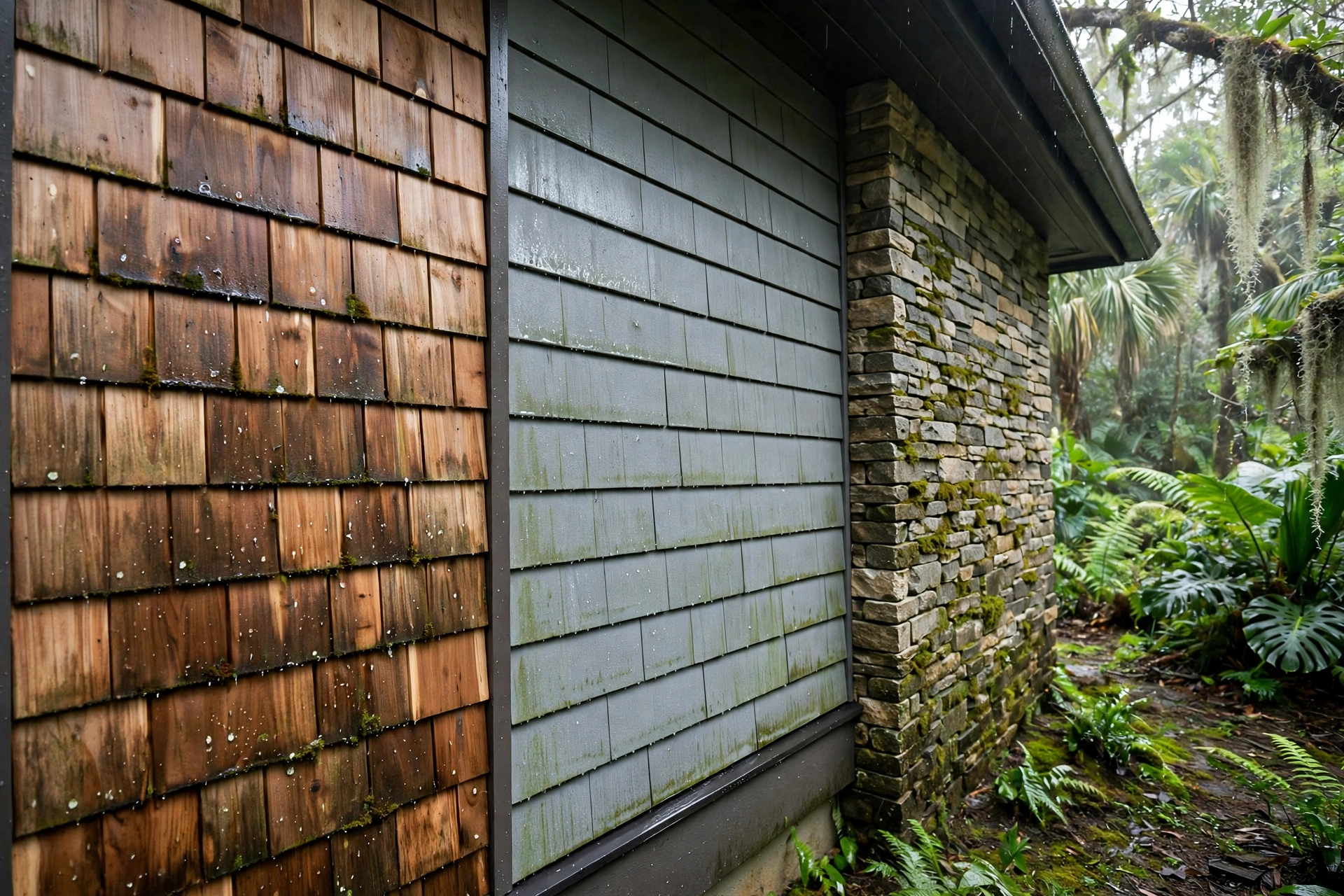
A home in a humid region rarely fails because it gets wet. It fails because it stays wet. Where summer air hangs heavy for months and nights bring little drying time, cladding lives in near-constant damp: paint peels from underneath, boards swell at their edges, and mold reaches wall cavities long before anything looks wrong from the street. Choosing cladding here is less about the prettiest finish and more about a system that sheds water, dries quickly, and does not feed mold or insects.
The Short Answer: Which Cladding Holds Up When the Air Never Dries Out
For most homes in humid regions, fiber cement cladding and brick or stone veneer are the strongest all-round performers. Fiber cement resists rot, insects, and warping, holds paint well, and does not feed mold. Masonry veneer is effectively immune to rot and, detailed with a drainage cavity, sheds water for decades with little upkeep. Powder-coated aluminum and properly specified steel are also excellent in humid and coastal air, provided fasteners and flashings resist corrosion. Vinyl costs less up front, but its seams can trap moisture if installation is imperfect. Timber looks superb but demands the most maintenance, and synthetic stucco needs expert detailing or it risks trapping water in the wall. A ventilated drainage gap behind the cladding matters at least as much as the cladding itself.
Why Humidity Punishes Exterior Walls Differently Than Rain Alone
Rain is a short event. Humidity is a condition. A wall in a dry climate gets soaked by a storm and dries within hours; a wall in a humid climate may never fully dry between wettings, because the air is already loaded with moisture and evaporation is slow. Cladding must therefore let trapped moisture escape, resist mold and algae, and stay stable through repeated wetting and drying. The three failure patterns are damp-fed fungi and insects, swelling joints admitting wind-driven rain, and vapor condensing on cool interior surfaces.
Fiber Cement Cladding in Sticky Air: The Workhorse That Rarely Rots
Fiber cement, made from cement, sand, and cellulose fibers, is the material most consistently recommended for humid regions. It does not rot, it is not food for termites or carpenter ants, and it is dimensionally stable, so it does not swell or warp the way wood-based boards can in sustained damp. Its dense surface absorbs little water, and because it is non-combustible it also carries a fire-safety advantage. It is heavy, so installation is slower and usually needs experienced installers with dust-controlled cutting, and cut edges must be primed and sealed. It holds paint far longer than timber, commonly around 10 to 15 years before repainting.
Brick and Stone Veneer When the Wall Needs to Breathe and Drain
Brick and stone veneer have protected humid-climate homes for centuries, and neither material rots, feeds insects, or supports mold growth on its own surface. A brick veneer wall is not a solid brick wall; it is a thin masonry skin tied to the frame with a cavity behind it, and that cavity is the whole point. Rain that penetrates the brickwork drains down the cavity and out through weep holes at the base, while air moving through the cavity helps the wall dry. The weakness is detailing: ageing mortar joints, failed flashing, and blocked weep holes. Specify clean cavities, unobstructed weeps, and through-wall flashing at every opening.
Vinyl Cladding in Humid Summers: Cheap to Fit, Easy to Trap Moisture Behind
Vinyl cladding is popular for good reasons: it is inexpensive, it never needs painting, it will not rot, and it shrugs off salt air better than untreated timber. But vinyl's weakness in genuinely humid climates is not the panel itself; it is what happens behind it. Installed as overlapping panels with seams and joints, vinyl lets water in if flashing, house wrap, or panel locking is imperfect, and then offers little ventilation to dry out. Because the panels hide the wall, mold and rot in the sheathing can advance unnoticed. Heat also warps vinyl nailed too tightly to allow for expansion. Choose premium thicker-gauge panels over a proper drainage plane.
Metal Cladding, Salt Air, and the Corrosion Question
Metal cladding, aluminum and coated steel in particular, is non-porous, so it does not absorb moisture, support mold, or feed insects, and it handles wind-driven rain well. Powder-coated aluminum suits coasts well: it does not rust like plain steel, and fluoropolymer coatings resist fading. Galvalume-coated steel, an aluminum-zinc alloy coating over steel, is also widely used in humid and coastal regions. The corrosion question is about the details, not the panel face: cut edges, scratches, dissimilar-metal contact, and ordinary steel fasteners are where rust starts in salty, humid air. In coastal zones, specify stainless steel or specially coated fasteners, isolate aluminum from steel with non-conductive barriers, and wash salt deposits off periodically.
Timber and Engineered Wood Cladding: Warm Looks That Demand a Drying Plan
Few materials look as good as timber, and species such as cedar have genuine rot resistance. But in a humid climate, timber is the highest-maintenance option here. Boards absorb moisture, swell, then shrink as they dry, opening joints; coatings break down faster under constant damp and strong sun; and any board that stays wet becomes food for fungi and insects. Engineered wood siding, wood strands or fibers treated with preservatives and bonded with water-resistant resins, is a step up: it looks like timber and resists decay and insects far better than solid wood. Its weakness is edge integrity. If the factory coating is chipped, or cut ends and bottom edges are left unsealed, moisture enters the core and boards swell at the edges, a defect hard to repair without replacing the board. Both types need back-priming on all faces.
Stucco and EIFS in Humid Regions: One Breathes, One Can Trap Water
Traditional three-coat stucco, cement, lime, and sand over metal lath, has a useful property in humid climates: it breathes. Moisture that gets into the wall can move back out through the porous finish, and a weep screed at the base lets water drain away. Well-maintained traditional stucco can last fifty years or more in humid regions, though every crack is a water entry point and sealant must be renewed as it ages. Synthetic stucco, known as EIFS, is a different system and a different risk. It layers foam insulation board over the sheathing with a polymer base coat and textured finish, and the finish is essentially non-porous. If water gets behind an EIFS layer through a crack, failed flashing, or an unsealed penetration, it cannot easily escape, and in a humid climate that trapped water can feed mold and rot in the framing behind the foam. Modern drained EIFS systems perform far better, but still demand expert installation and regular inspection.
The Rainscreen Gap: The Detail That Matters More Than the Material
A rainscreen is not a product. It is an assembly: cladding fixed to battens or a drainage mat over a weather-resistant barrier, leaving a continuous air gap, typically around three quarters of an inch, between the back of the cladding and the wall. That gap does three jobs no cladding material can do on its own: it drains bulk water down and out at the base, it ventilates so the wall dries, and it equalizes pressure so wind cannot push rain through joints the way it can in a sealed wall. In humid climates, the rainscreen gap is arguably the single most valuable upgrade you can specify, whatever cladding you choose. Ask installers how they create the gap, vent it top and bottom, and flash the base.
- Confirm the weather-resistant barrier is continuous and taped at seams before cladding goes on.
- Fix vertical battens or a drainage mat to create an unobstructed gap behind the cladding.
- Vent the cavity at top and bottom, with insect screening that does not block airflow.
Humid-Climate Cladding Side by Side: Durability, Upkeep, and Price Ranges
No material wins on every measure: fiber cement and masonry lead on durability, vinyl on up-front cost, metal on coastal corrosion resistance, timber on appearance. Costs below are broad estimates only.
Cladding Mistakes That Turn Damp Air Into Wall Damage
Most humid-climate cladding failures are installation failures, not material failures. Cladding run down into soil or mulch wicks moisture straight into boards and sheathing; every cladding type needs clearance above finished ground level. Sealant ages fastest in sun and damp, so windows, hose bibs, and light fixtures need periodic resealing. Perhaps the most expensive mistake is painting or cladding over a wall that is already damp, sealing moisture inside where it can only do damage: always let a wall dry, find the water entry point, and fix the flashing before covering it up. Mixing incompatible metals is another classic error: an aluminum panel fixed with plain steel screws in salty, humid air will corrode at every fixing point. Use manufacturer-specified fasteners for your exposure zone and keep shrubs clear of the wall.
When a Cladding Job in a Humid Zone Needs a Specialist, Not a Weekend DIY
Lightweight vinyl on a simple wall suits a skilled DIYer; most humid-climate cladding work does not. Fiber cement is heavy and produces hazardous silica dust when cut, so it needs dust-controlled cutting and proper handling. Masonry veneer requires structural ties, lintels, and flashing knowledge beyond cosmetic work. EIFS and rainscreen assemblies demand detailing at every window, roof junction, and base flashing that a general handyman rarely gets right first time, and in humid regions a detailing error stays hidden until damage is extensive. Bring in a specialist installer for whole-house recladding, any EIFS or rainscreen system, a coastal exposure zone, or a wall already showing moisture damage such as staining, soft sheathing, or a musty smell indoors. Get a moisture survey before recladding; structural or multi-story work may need permits.
Cladding Verdict: Picking the Humid-Climate Skin Your Home Will Live With
Start from your exposure, not from a brochure. A home a few streets from the sea faces salt as well as humidity, pushing the choice toward powder-coated aluminum, coated steel, fiber cement, or masonry. Inland, fiber cement or brick veneer usually give the best balance of durability and upkeep. If budget forces vinyl or engineered wood, spend the saving on installation quality: a proper drainage gap, meticulous flashing, and corrosion-resistant fasteners will do more for the wall's life than upgrading the panel itself. In a humid climate, the wall that dries is the wall that lasts.
Humid-Climate Cladding Questions Homeowners Keep Asking
Does fiber cement cladding really resist mold in a humid climate?
Yes, in the sense that matters most: fiber cement is not an organic food source for mold, it does not rot, and its dense surface absorbs little water. Algae and mildew can still grow on damp surfaces, especially shaded walls, but a yearly wash usually removes it.
Can vinyl cladding be a safe choice in a very humid region?
It can, but only with careful installation: thicker-gauge panels, allowance for thermal expansion, and above all a continuous weather-resistant barrier, correct flashing, and a drainage path behind the panels. If the wall cannot drain and dry, trapped moisture can damage sheathing unseen.
How do I know whether my home's stucco is traditional or synthetic?
Knock on the wall: traditional stucco sounds and feels solid, like concrete or masonry, while EIFS usually sounds hollow and feels slightly soft. At penetrations such as light fixtures, foam board behind the finish indicates EIFS, while metal lath indicates traditional stucco..
Is a rainscreen gap worth the extra cost on a reclad?
In a humid climate, yes. The gap is usually a modest part of the total recladding cost, and it is the detail that lets every cladding material drain and dry. Without it, even a rot-proof panel can sit against a permanently damp wall.
Which cladding needs the least maintenance in humid weather?
Brick and stone veneer need the least routine attention, provided cavities and weep holes stay clear, followed closely by fiber cement and powder-coated metal. Timber needs the most upkeep, and EIFS needs the most vigilance, since its failures hide behind the finish.
Should cladding touch the ground in a humid garden?
No. Keep all cladding clear of soil, mulch, and standing water, at least 150 mm above finished ground level per local code. Ground contact wicks moisture into boards, invites termites, and blocks the base drainage gap.