Cracks in the drywall, doors that no longer close, sloping floors, and gaps around window frames are rarely just cosmetic problems. They are often the visible symptoms of a foundation that is settling or moving, and ignoring them lets the damage spread from the foundation to the whole structure. The best foundation repair methods for homes experiencing settlement and structural movement are steel push piers and helical piers for deep underpinning, slabjacking or polyurethane foam injection for sunken slabs, and wall anchors or carbon fibre straps for bowing basement walls, each matched to the specific cause of the movement.
The direct answer is that there is no single best method, because the right repair depends on what is moving and why. Settlement caused by weak surface soil needs underpinning that transfers the load to deeper, stable ground. A sunken concrete slab needs levelling, not piers. A bowing wall needs lateral support, not lifting. A proper diagnosis by a structural engineer comes first, and the repair method follows from that diagnosis.
Reading the Signs That Your Foundation Is Settling
Foundation movement rarely announces itself loudly. It starts with small clues: hairline cracks that widen over months, cracks that run diagonally from the corners of doors and windows, a floor that slopes toward one corner, or a gap opening between the wall and the ceiling. Outside, look for stair-step cracks in brickwork, a chimney leaning away from the house, and gaps where the foundation meets the siding.
The pattern of the cracks tells you a lot. Vertical cracks in a foundation wall are often shrinkage and may be harmless, while horizontal cracks, wide diagonal cracks, and cracks wider than about a quarter of an inch usually signal structural movement. Measure and photograph cracks, note the date, and check them again in a few months. A crack that is growing is a crack that needs professional attention, and the sooner it is assessed, the cheaper the repair is likely to be.
What Actually Causes a Foundation to Settle and Move
Foundations move because the soil beneath them changes. Expansive clay soils swell when wet and shrink when dry, cycling with the seasons and slowly tearing at the foundation. Poorly compacted fill soil compresses under the weight of the house, so one corner sinks. Poor drainage lets water pool against the foundation, softening the soil and increasing hydrostatic pressure. Plumbing leaks, tree roots drawing moisture from the soil, and nearby excavation can all trigger movement too.
Differential movement is the most damaging kind: one part of the house settles while another stays put, or one part heaves upward while another sinks. That uneven motion is what cracks walls, jams doors, and slopes floors. Understanding whether your home is settling, heaving, or both is essential, because the repair for settlement is very different from the repair for heave, and treating the wrong one can make things worse.
Steel Push Piers: The Workhorse of Foundation Underpinning
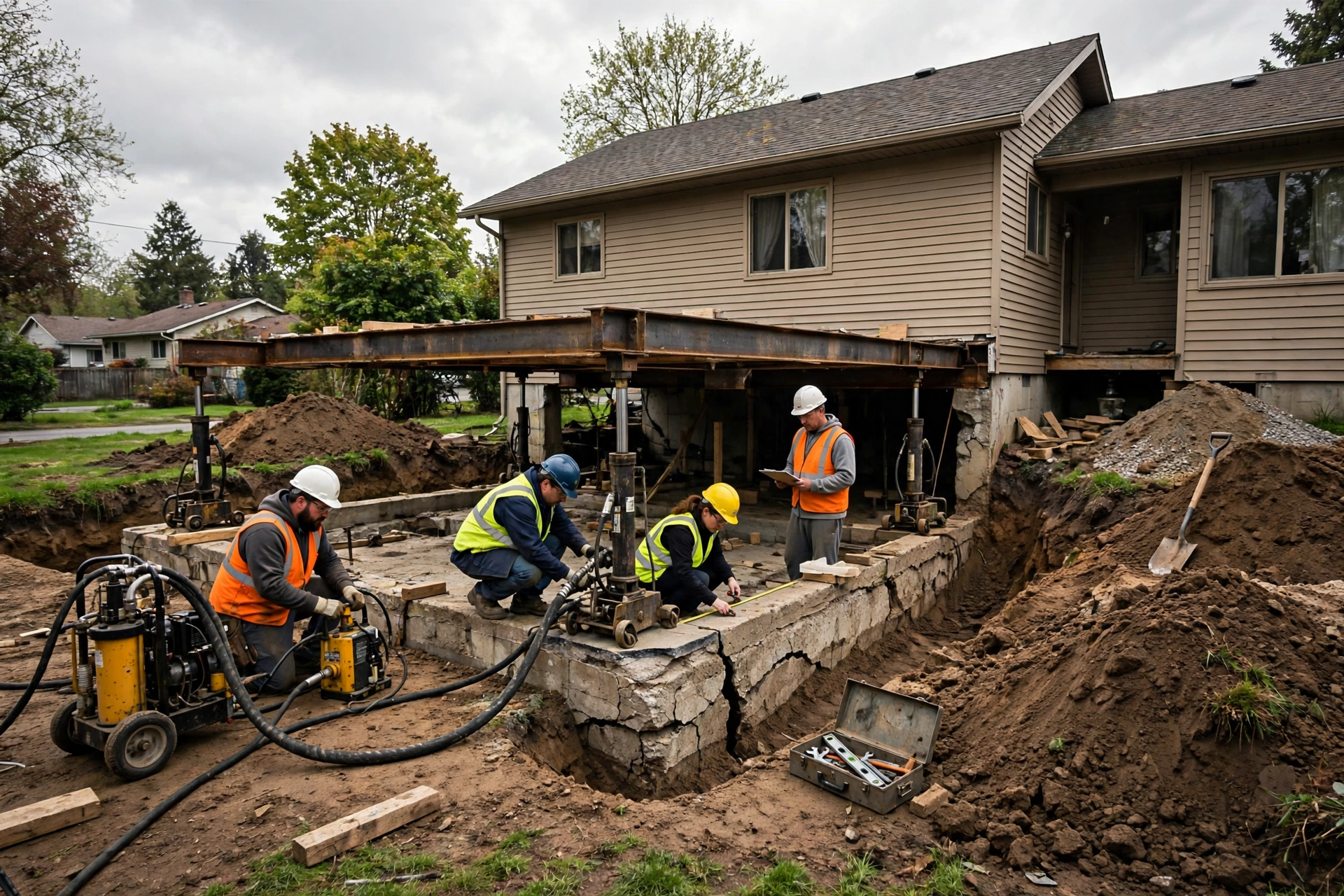
Steel push piers, also called resistance piers, are the most common method for stabilising a settled foundation. The crew excavates a small section beside the footing, attaches a steel bracket, and uses hydraulic rams to drive segmented steel pipes deep into the ground, using the weight of the house itself as the reaction force. The pipes are driven until they reach refusal in dense soil or bedrock, then the bracket is locked and the foundation is stabilised, and in many cases lifted partway back toward its original level.
Push piers work best for heavier structures where a stable bearing layer is reachable, and they can be installed with minimal disruption to landscaping. Their main limitation is depth: if the stable layer is extremely deep, the cost rises with every extra pipe section. A typical pier costs a broad range of roughly fifteen hundred to three thousand dollars installed, and a house may need several, so a full underpinning project is a significant investment, though it is usually the most permanent fix available.
Helical Piers: Screwing Down to Stable Ground
Helical piers, also called helical piles, are steel shafts with spiral plates that are screwed into the ground like a corkscrew, using a hydraulic drive head. They are particularly effective for lighter structures, such as porches, additions, and single-storey homes, and in areas where bedrock is very deep, because they do not rely on the weight of the structure to drive them. The torque required to install them confirms the load capacity, which gives engineers a measurable record of the bearing strength.
They also suit new construction on difficult sites, not just repairs. Cost per unit is broadly similar to push piers, and the choice usually comes down to the structure’s weight, soil conditions, and depth to stable ground, which is why an engineer’s soil assessment matters so much.
Slabjacking and Polyurethane Foam Injection for Sunken Slabs
When a concrete slab, such as a driveway, patio, or slab-on-grade foundation, has sunk because of voids beneath it, underpinning is usually unnecessary. Instead, the slab can be levelled from below. Traditional mudjacking, or slabjacking, pumps a cement-based slurry through small holes drilled in the slab, filling the voids and lifting the concrete back toward level. It is a proven, relatively affordable method that has been used for decades.
Polyurethane foam injection, often called polyjacking, does the same job with expanding foam instead of slurry. The foam is lighter, cures quickly, and requires smaller holes, so it is popular for interior slabs and areas where weight matters. Both methods are suitable for non-structural levelling, but neither fixes a foundation that is settling due to weak soil at depth. If the slab is part of the home’s structural foundation and the settlement is ongoing, underpinning is the correct repair, not levelling.
Wall Anchors, Braces, and Carbon Fibre for Bowing Basement Walls
Basement walls bow inward when lateral soil pressure, usually from saturated clay or hydrostatic pressure, pushes against them. Wall anchors solve this by connecting the wall to a steel anchor buried in stable soil 12 to 15 feet out in the yard, allowing the wall to be pulled back toward straight over time. Steel I-beam braces, installed vertically against the wall and anchored to the floor and joists above, are another option, especially where there is no yard access for anchors.
Carbon fibre straps are a newer, less invasive option, bonded vertically to the wall face to stop further inward movement, though they cannot straighten a wall that has already bowed significantly. They suit early-stage bowing and walls where anchors or braces are impractical. All three methods also need the drainage problem behind the wall addressed, or pressure will keep building and eventually defeat the repair.
Comparing Foundation Repair Methods Side by Side
Use this comparison to understand your options, not to choose a method yourself. The right repair depends on soil reports, load calculations, and the exact pattern of movement. A contractor who recommends one method for every house is selling a product, not a diagnosis.
Drainage and Grading: The Repair That Protects Every Other Repair
Water is the engine behind most foundation movement, so fixing drainage is often the highest-value part of any repair. Gutters and downspouts should carry water at least several feet away from the house, and the ground should slope away from the foundation for the first several feet.
- French drains carry groundwater away from the footing.
- Surface grading slopes water away from the walls.
- A sump pump and interior drainage control hydrostatic pressure in basements.
Complete drainage work alongside the structural repair, because a pier or anchor installed in soil that keeps moving will eventually fail the same way the original foundation did.
Foundation Repair Missteps That Waste Money and Time
Patching cracks with filler or epoxy without addressing the movement behind them, so the cracks simply reopen.
Hiring a contractor who recommends one method for every home without a soil or engineering assessment.
Choosing slab levelling for a foundation that is settling at depth, which lifts the slab temporarily but does not stop the settlement.
- Installing piers without fixing drainage, so the soil keeps shifting and the repair is undermined.
- Lifting a foundation too far or too fast, which can crack walls, break plumbing, and damage finishes upstairs.
- Skipping permits and engineering sign-off, which can cause problems with insurance and resale.
The most expensive foundation repair is the one that has to be done twice. A proper diagnosis, an engineered solution, and drainage correction together cost more upfront, but they are far cheaper than repeating a failed repair a few years later.
When Foundation Movement Is an Emergency, Not a Project
Most foundation problems develop slowly, but some need immediate action. Call a structural engineer right away if you see a wall bowing visibly, a crack that is growing week by week, a floor that has dropped noticeably, or water pouring through a foundation crack. A smell of gas, a carbon monoxide alarm, or a sudden shift after an earthquake or flood are also emergencies. Do not wait for a convenient time to address these, and do not let anyone begin lifting or underpinning work without an engineer’s plan.
Foundation repair is also one of the few home improvement jobs where permits and inspections are not optional. Underpinning, wall anchors, and structural crack repairs all require engineering design and local approval in most areas. A reputable contractor will handle permitting and welcome inspection, and any contractor who suggests skipping it should be avoided.
Foundation Settlement FAQs
How much does foundation repair cost?
Costs vary widely with the method, pier count, and soil conditions. As a broad guide, a single pier typically costs roughly fifteen hundred to three thousand dollars installed, slab levelling is usually much less, and a full underpinning project can run into the tens of thousands. Always get an engineer’s assessment and several detailed quotes before committing.
Can a settled foundation be lifted back to level?
Often, partially. Once piers reach stable ground, hydraulic jacks can lift the foundation back toward its original position, but a full return to level is not always possible or safe. Lifting must be done slowly and evenly to avoid cracking walls and damaging plumbing. Stabilising the foundation to prevent further movement is the primary goal, and any lift is a bonus.
How long does foundation repair take?
Most underpinning projects take two to five days on site, depending on the number of piers and access conditions. Slab levelling can often be done in a single day, while wall anchor installation typically takes one to two days. Engineering assessment and permitting add time before work begins, so plan for several weeks from first inspection to completion.
Is foundation settlement covered by home insurance?
Usually not. Standard home insurance policies generally exclude settlement, soil movement, and earth movement, though sudden damage from a covered event such as a burst pipe or a flood may be covered. Check your policy and speak to your insurer, but do not assume settlement repairs will be paid for.
Do I need a structural engineer or just a foundation contractor?
You need both, in that order. A structural engineer provides an independent diagnosis and specifies the repair, while the contractor carries it out. Relying on a contractor’s free assessment alone can lead to the wrong method being sold, since the contractor has an interest in selling their own system. An engineer’s fee is a small fraction of the repair cost and protects you from expensive mistakes.
Can I prevent foundation settlement in a new home?
Largely, yes. Proper soil compaction before construction, good drainage and grading, consistent moisture around the foundation, and piers or deep footings in expansive clay soils all reduce settlement risk. If you are building on difficult soil, a geotechnical report before construction is one of the best investments you can make.
Final Thoughts: Diagnose First, Then Repair Your Foundation Right
The best foundation repair method for a home experiencing settlement and structural movement is the one that matches the cause, not the symptom. Steel and helical piers stabilise deep settlement, slabjacking and foam injection level sunken slabs, and wall anchors and carbon fibre hold back bowing walls, but none of them work without fixing the drainage and soil conditions that caused the movement. Start with a structural engineer’s assessment, get an engineered repair, correct the water, and your foundation can be stabilised for decades to come.